Honestly, I’ve always had a strange feeling about turtles. Not just because they’re cute creatures with their big shells, coming and going, but because there’s a kind of philosophy of life hidden in that small body and heavy shell.
The way a turtle moves slowly but always moves forward sums up life for me: slow, but steady progress on the path of life.
Now let me tell you exactly what we can learn from a turtle; things that are scientific, philosophical, and practical in our daily lives.
- Going slow and moving forward is important, not falling behind
The famous story of “The Rabbit and the Turtle” that we read as kids isn’t just a fable—it’s a real mental model.
According to a study in Harvard Health, people who live with a slower, more mindful pace have lower stress levels, make more precise decisions, and live longer.
Like turtles, they don’t run aimlessly and hastily; they experience the path with attention. They understand that life is not a race where we must run to avoid falling behind. What and who are we falling behind from? Does it even matter? What matters is that we walk our life’s journey beautifully.
I remember when I first started yoga, my body was as stiff as a board! My back was hunched from sitting behind a laptop for so long. But with this turtle-like teaching, I moved forward—slowly but steadily, with patience, step by step, day by day.
Now, after a few years, not only has my body changed, but my mind has also become more flexible. And I still move forward slowly and steadily.
In a world where everything moves at the speed of light—from the internet to conversations, from career growth to social media—those who can stay calm are, in fact, stronger.
Turtles teach us that calmness is an active choice.
Not from inaction, but from awareness.
Knowing that every move is meant to reach a destination, why rush?
- Turtles always carry their home with them – it’s inner security
Maybe the most beautiful feature of turtles is that wherever they go, their home is with them.
That big shell not only protects them, but it’s also a symbol of “inner security.”
We humans usually seek external shelters—home, relationships, money, success—but turtles teach us that “true security comes from within.”
When your inner self is calm, anywhere can be home.
In positive psychology, this feeling is called inner stability—a sense of calm and inner stability that stays with you regardless of external circumstances.
That’s what yoga tries to awaken in you.
Maybe one reason turtles appear slow is because inside, there’s no storm—there’s peace.
- To move forward, you don’t need to flail around
I first realized this while diving.
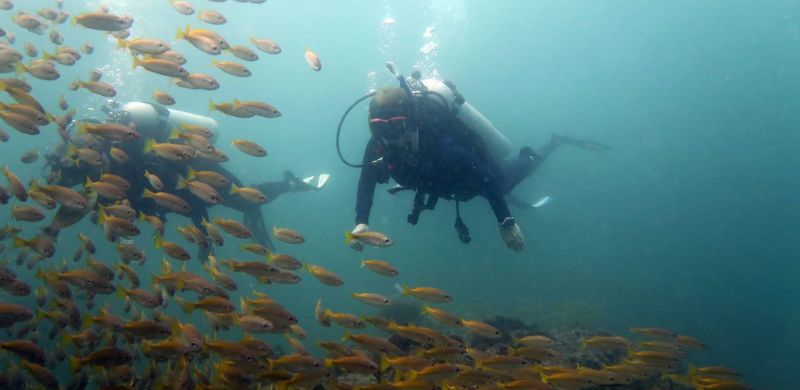
I was in Zanzibar. We got on a boat, excited, full of energy, and making a lot of noise. I was asking about the water, getting excited about seeing dolphins, laughing… until I went into the strong current during our dive.
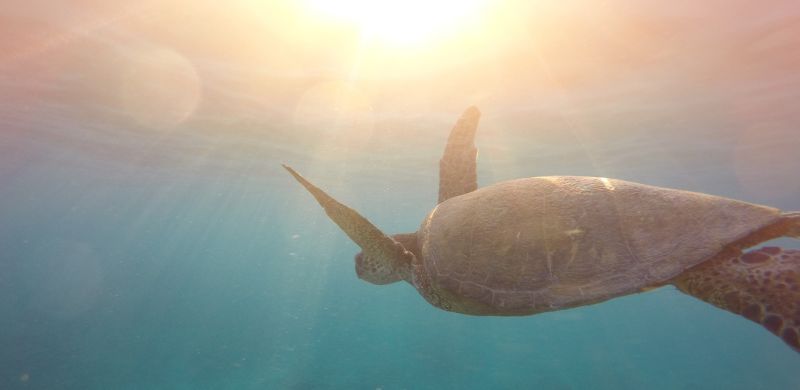
The current was so strong that I couldn’t keep myself afloat, and I kept struggling. Then, I saw a turtle. In the current I couldn’t handle, it was calmly standing by a rock, and I remembered that the closer I got to the rock, the less the current was. Then, slowly and gently, it lifted its fins and swam away, so gracefully that it felt like flying.
At that moment, I felt the world suddenly calm down.
When I came up, I was sitting quietly in the boat, staring at the sea, and my dive master asked, “Are you okay?”
Because he noticed there was no noise or excitement, he was concerned.
I smiled and looked at him, saying, “Yeah, I’m good… this is the Turtle Effect!”
There really is something called the Turtle Effect—maybe it’s not scientific, but it’s a deep metaphor:
It’s the moment when you realize you don’t need to flail around. You just need to make the right move and let the flow of water carry you to where you need to go.
This concept in psychology is similar to the flow state—the moment when focus, calm, and joy merge. The turtle was exactly in this state in the water.
“I hope this Turtle Effect is in all of our lives.”
What does that mean? It means that whenever life gets tough, think of the turtle.
Remember its soft, steady strokes in the water.
When you feel restless, like you need to flail around, prove something, or rush…
Take a moment to breathe, look around, and then just take one step. That’s enough.
- Harmonize with nature, not against it
Turtles have been on Earth for 220 million years—since the time of dinosaurs—and they’re still here.
Do you know why? Because they didn’t fight nature.
They weren’t trying to control everything, they weren’t in a rush, and they didn’t create a commotion.
We tend to want to control everything:
precise planning, goal-setting, order… which is great, but if you let nature take its course at times, life becomes much lighter.
Turtles know how to harmonize with the seasons, weather, and their environment.
In Tao philosophy, there’s a quote that fits turtles perfectly:
“The softest thing in the world overcomes the hardest.”
Just like water that finds its way through stone. Not with force and pressure, but with softness, slowness, and persistence.
- Time is not the enemy of the turtle
Did you know some species of turtles can live up to 180 years?
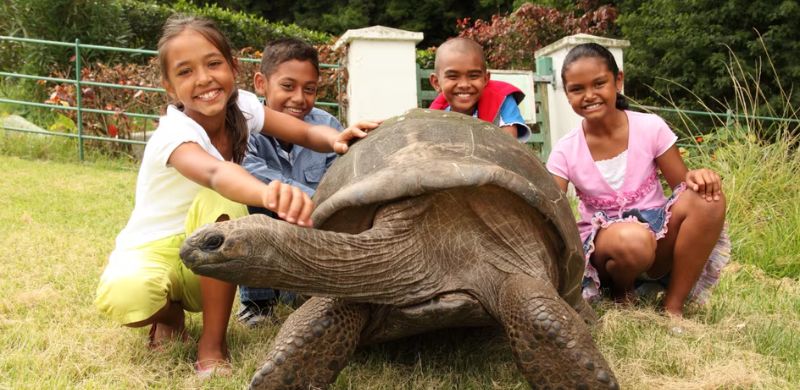
The giant turtle from the Seychelles named Jonathan is still alive at 191 years old!
Imagine, he’s lived nearly two centuries, with no hurry.
This longevity sends a message:
Living slowly means living longer.
People who are constantly stressed, rushing, competing, and pushing themselves have their nervous systems constantly active, which leads to premature aging.
But if you move like a turtle, at your own pace, your brain stays relaxed.
In Qi Gong philosophy, it’s said that creatures have a fixed number of breaths in their lifetime. So, the more you breathe calmly and deeply, the longer you can live.
- Every progress is made by repetition, not leaps
Turtles go a small path every day, but they always keep moving forward.
They teach us that perseverance is more important than speed and short-term motivation.
Yoga is just like this.
Simple movements like Sun Salutations, when repeated every day, will change your body deeply.
Not all at once, not with a miracle, but with persistence.
Maybe you’ve heard this from yoga instructors a lot: “Just practice, and everything will be fine.”
It means just take a step, and the result will come by itself.
The turtle lives exactly like this—calm and quiet, but with trust and faith in its path.
- Sometimes, you need to pull your head into your shell
We all need to take a step back from the world at some point.
Not out of anger or boredom—just to recharge.
When a turtle feels threatened, it pulls its head into its shell.
Not to run away, but to protect itself.
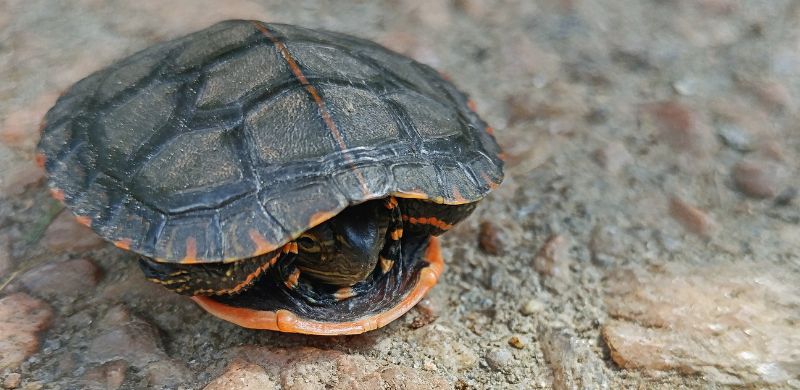
It knows when to be silent and when to step back from the noise.
In today’s world, full of notifications and noise, “going into your shell” can be a skill, not a weakness.
It’s called digital retreat or mindful isolation—a return to oneself.
- Turtles are symbols of wisdom and longevity
In many cultures, turtles are sacred symbols.
In Native American mythology, the Earth is depicted as resting on the back of a giant turtle.
In Eastern philosophy, turtles are symbols of patience and wisdom.
Even in Hinduism, the goddess Vishnu appears in one of her incarnations as a turtle, holding the world on her back.
This small creature has been a teacher to humans for thousands of years—teaching patience, balance, and survival.
Summary
If I had to sum up all of this in one sentence, it would be:
Learn from the turtle to move with calm, be kind to yourself, enjoy the journey, and trust in time.
Not faster, not slower—just at your own pace.
And if one day you feel like the world is moving faster than you,
think of that turtle in Zanzibar who moved softly towards the horizon, never in a rush.
In that moment, you might realize that happiness is exactly right there: between two soft strokes.
Your email address will not be published. Required fields are marked *
Comment Remaining characters: 300